
Aachen Cathedral
Aachen Cathedral: The Building That Looks the Wrong Way
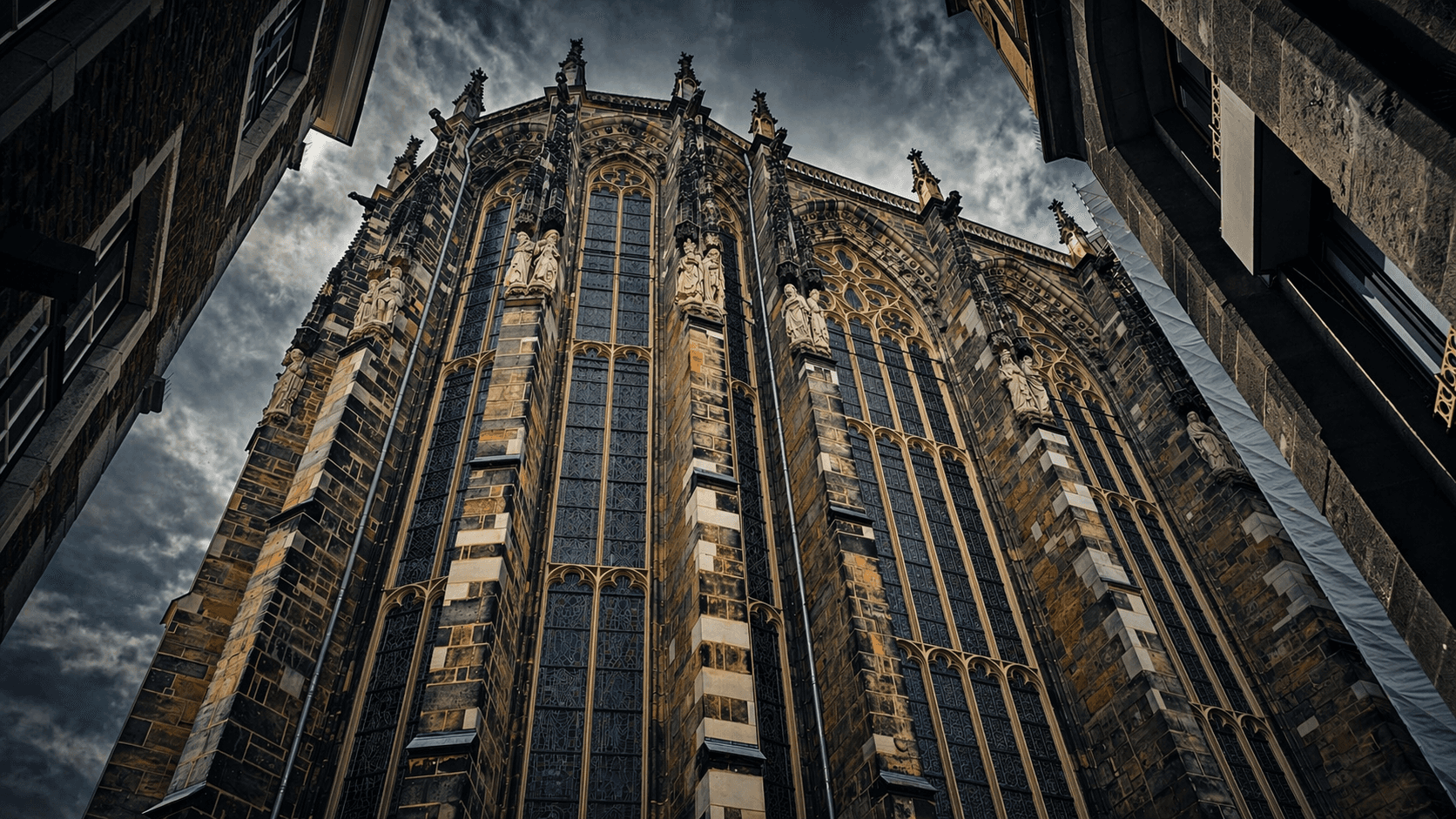
Aachen Cathedral gets the geography wrong on purpose.
You expect a building this important to face where important buildings face, toward Rome, or at least toward whichever cardinal point flatters it. Instead the octagon Charlemagne raised in 796 points toward Ravenna, a city six hundred kilometers south that most visitors standing under the dome have never been to and couldn't find on a map. That's the detail worth sitting with before anything else. He wasn't building a chapel. He was quoting one.
The quote was San Vitale, the sixth century Byzantine church Charlemagne had seen with his own eyes on campaign in Italy. Octagonal plan. Central dome, with a gallery wrapping the perimeter on two levels. None of that belongs to Romanesque logic, and none of it belongs to the Gothic that would dominate German church-building for the next five hundred years. It belongs to Constantinople, dropped into a river valley on the edge of Frankish territory like a diplomatic cable nobody local could read yet. Whose heir did he think he was? The building answers before the history books do.
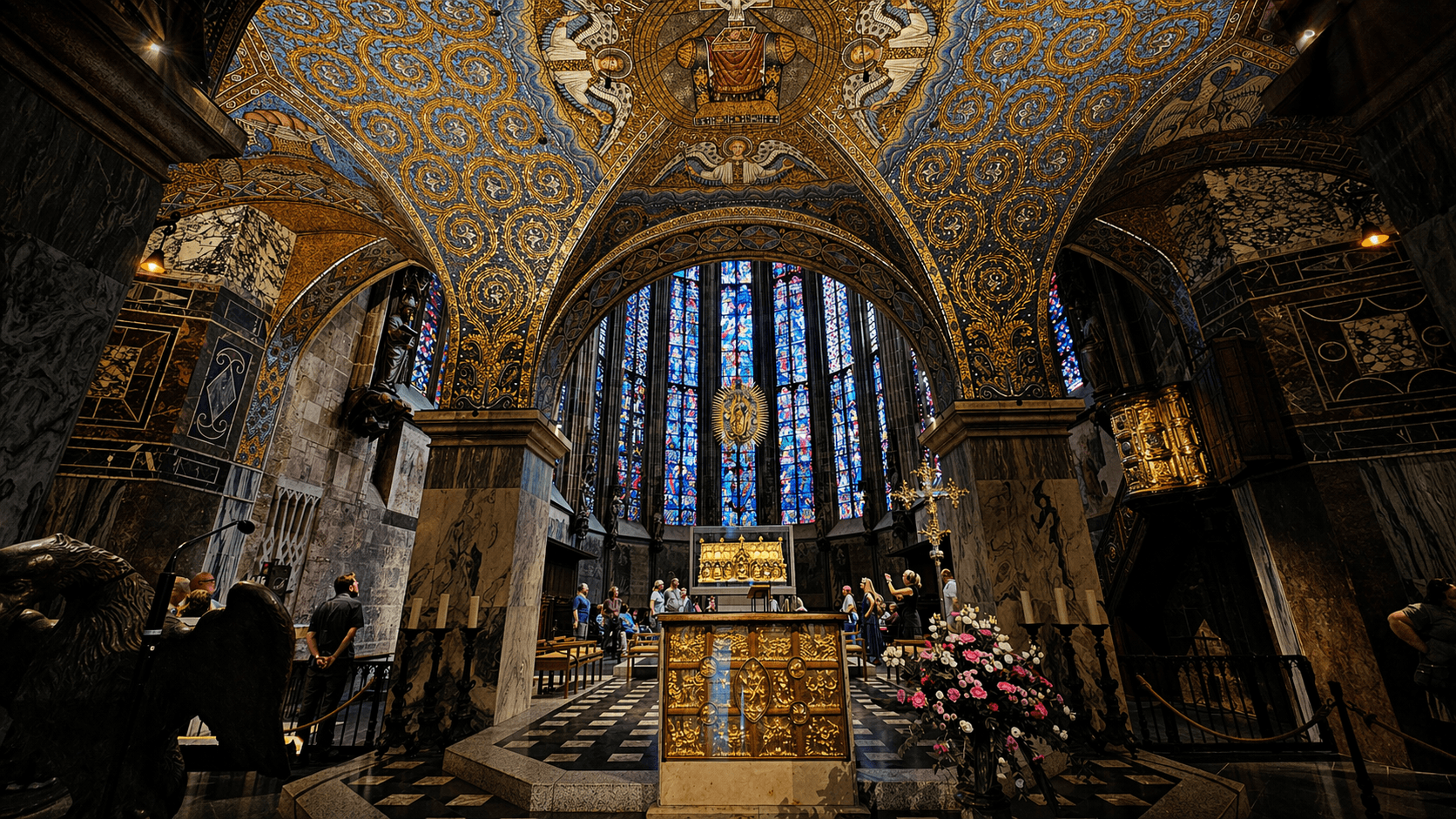
Which explains something that trips up almost everyone who visits after Cologne or after Metz. Gothic cathedrals organize a body vertically, floor, eye, vault, sky, one direction, no ambiguity about where you're supposed to look and how small you're supposed to feel doing it. Aachen refuses that grammar. Stand in the center of the octagon and the space doesn't climb away from you. It circles you. You're not moving toward an altar so much as arriving at a point everything else was arranged around. First-time visitors read this as underwhelming. It isn't underwhelming. It's a different claim on the body entirely, and most people don't have the vocabulary for a church that includes them instead of dwarfing them.
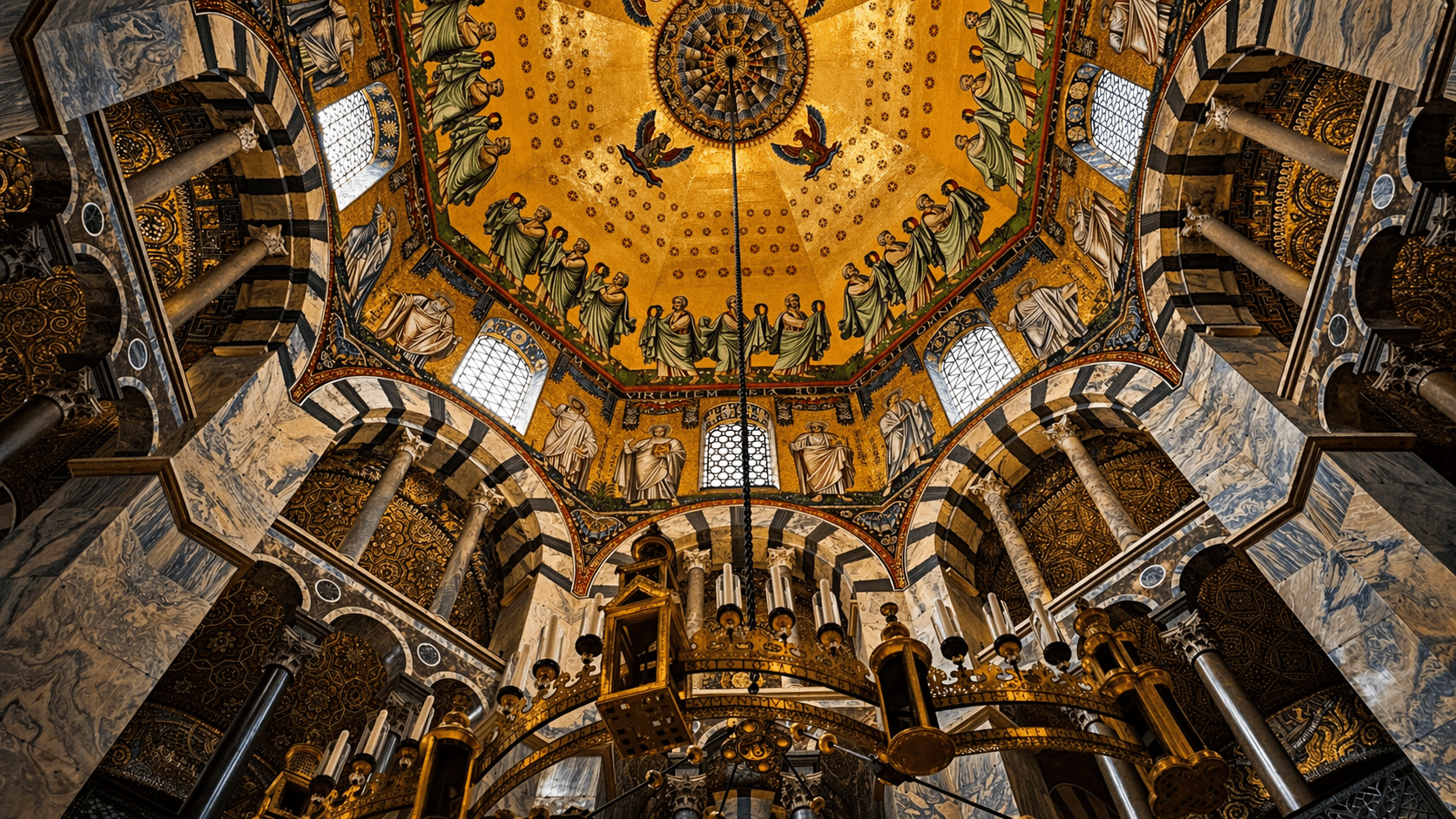
Here's the detail that doesn't fit the pretty version of this story. The mosaic overhead, gold ground, Christ ringed by the elders of the Apocalypse, looks old enough to have watched Charlemagne's coronation. It hasn't. The original didn't survive, and what hangs there now came out of a nineteenth-century restoration commissioned when Wilhelmine Germany decided an imperial symbol needed to look the part. So the ceiling everyone photographs is a nineteenth century fantasy of an eighth century idea, executed with enough skill that almost nobody clocks the gap. Stand under it long enough and you start to wonder how much of what reads as medieval in Europe is actually just very good nineteenth-century conviction.
Then there's a third building stacked into the same footprint. The Gothic choir, added in the fourteen hundreds, runs on completely different rules from the octagon it's grafted onto. Elongated windows, ribbed vaults. Light that behaves nothing like the light six meters away under the dome. Walk from one into the other and you feel the grammar change under your feet before you've consciously registered why. Three centuries didn't restore this building. They argued with it.
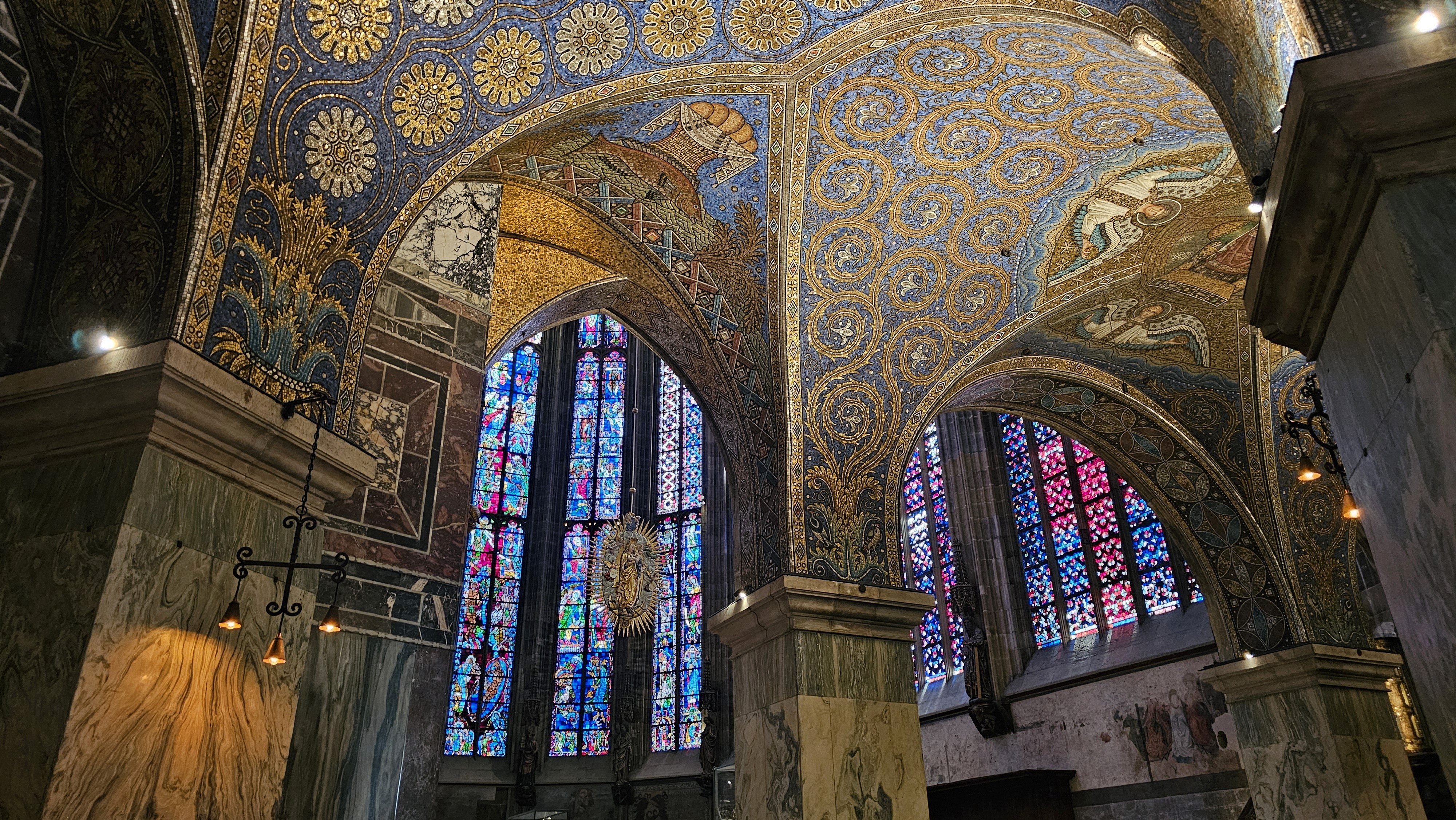
I keep coming back to a phrase from the Atlas Aura method for exactly this kind of site: adaptive reuse. But Aachen resists the tidy version of that idea, the one where a shell survives and only the function changes underneath it. That's not what happened here. Every layer added a claim, not just a use. The Carolingian chapel became a coronation site. The coronation site grew a Gothic choir to house relics worth defending. The reliquary got dressed in an imperial mosaic centuries before anyone thought to ask whether an eighth-century emperor would have recognized his own church. Each generation wasn't renovating. It was arguing with the generation before it, in the same stone, without asking permission.
So the cathedral doesn't produce one impression, and that's not a failure of the building. It's the honest result of what it actually is. Metz is whole: one century, one intention, one upward line you can trace with your eyes without effort. Aachen is at least three buildings occupying one address, none of them agreeing to defer to the others.
Stand in the center long enough and you'll feel it happen. The mosaic pulls your eye up into a century that wasn't there for the coronation. The choir pulls your attention sideways into a Gothic argument the octagon never asked for. Underneath both, an eighth-century floor plan quietly points at Ravenna, like nobody's told it the empire it was flattering doesn't exist anymore.
Nothing here resolves. That's the part nobody puts on the plaque.
Comments
About Me

The Atlas Aura
Welcome to The Atlas Aura – I’m Antares, the storyteller behind the journey. Alongside my husband and our little son, we explore the world together, turning everyday moments into lasting memories. With a deep passion for uncovering hidden corners of the world, we craft cinematic travel experiences that blend culture, authenticity, and wonder.
Read More
World War II advertising posters on display at the Museum of the Second World War in Gdańsk.
Update on 7 Jun 2025

Tallinn Maritime Museum: Sailing Through Estonia's Living History
Update on 1 Jun 2025
Domes, Democracy, and a Dash of Awe: Visiting Hungary’s Parliament with My Family.
Update on 4 Jun 2025